Protocol Overview
The Encrypted ERC system combines smart contracts and zero-knowledge circuits to create a privacy-preserving token system on the blockchain. While traditional tokens expose all transaction details publicly, Encrypted ERC ensures that balances and transfer amounts remain confidential while maintaining verifiability.
The protocol has two versions: Standalone and Converter. Each one has different functions designed for specific uses in the token ecosystem.
Standalone Version
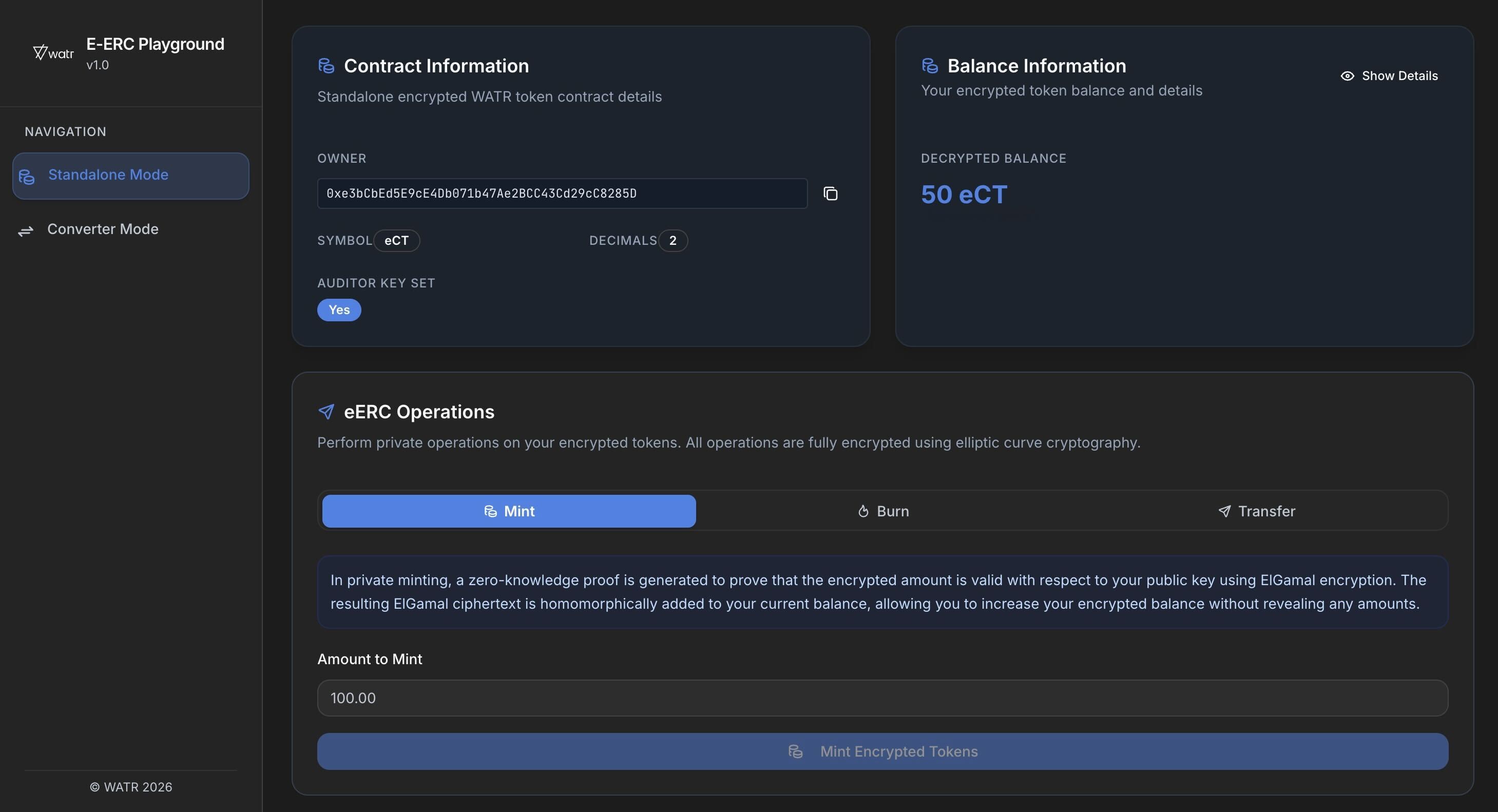
The Standalone version lets users create new private tokens. This is similar to creating a standard ERC-20 token, where you also set a name and symbol for the token. It’s perfect for users who want to launch new tokens with built-in privacy features.
Key features of the Standalone version include:
-
Native encrypted supply
You define a name and symbol (for exampleeCOPT) and control minting and burning directly on the encrypted token. -
Private minting
New units are created through a mint operation that:- increases total encrypted supply, and
- emits encrypted commitments instead of public balances,
while a zero-knowledge proof shows that the operation respects your supply rules.
-
Private burning
When positions are retired or settled, a burn operation:- consumes encrypted commitments, and
- reduces total encrypted supply,
again with a proof that confirms the operation is legitimate without revealing the exact amounts.
You can think of Standalone mode as: “if ERC-20 had been designed for private commodity ledgers from day one.”
Converter Version
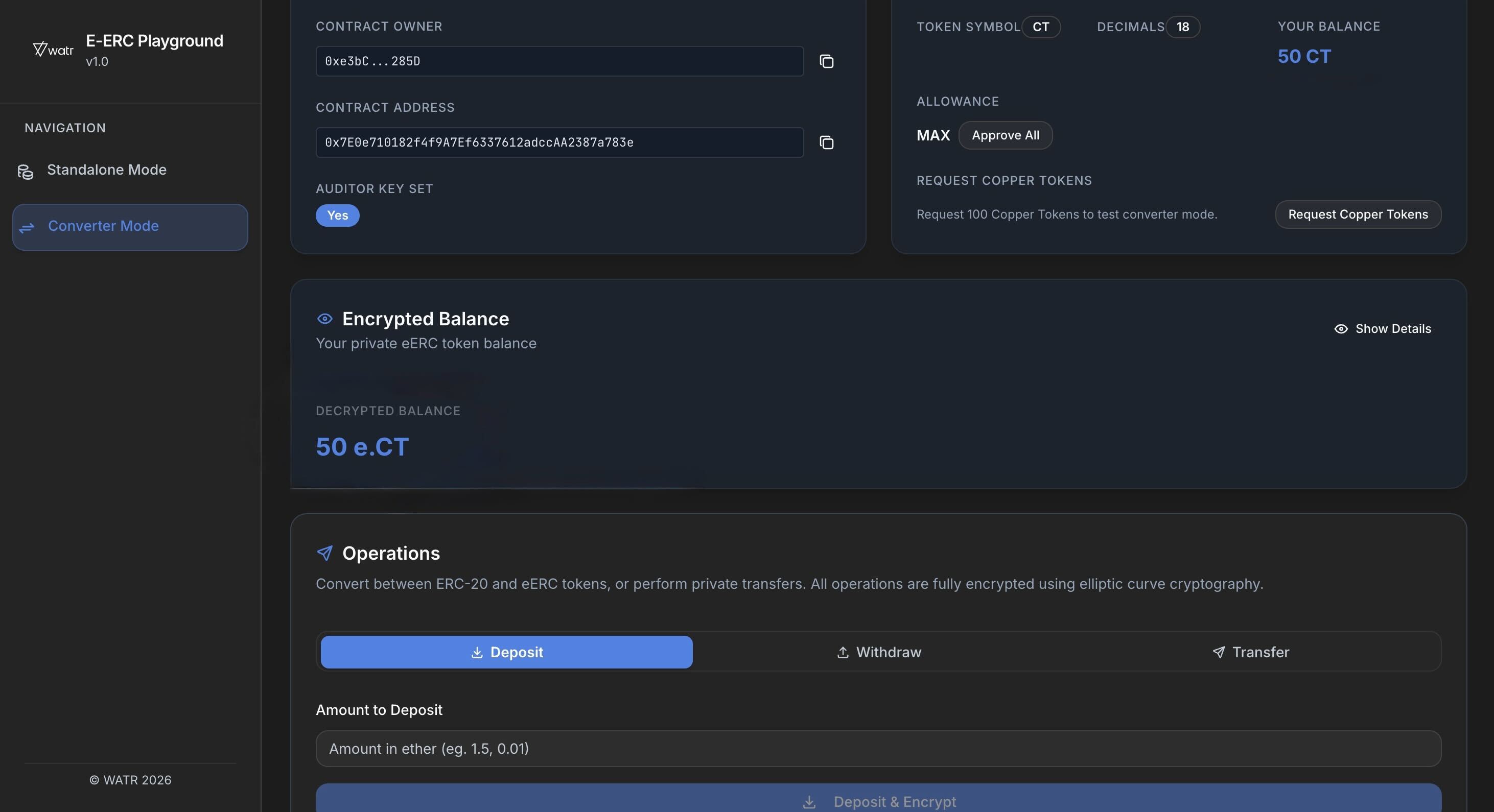
The Converter version is for adding privacy features to existing tokens. It converts standard ERC-20 tokens into private versions, providing privacy without changing the original token setup.
Key functions of the Converter version include:
-
Deposit: Users can deposit their existing ERC-20 tokens into the system to convert them into private tokens, keeping the original token features intact while adding privacy.
-
Withdraw: This lets users take out their private tokens, giving them the ability to switch their tokens between private and public as needed.
Structure
The system employs various circuits to handle different operations. The Registration Circuit verifies the user’s cryptographic credentials, ensuring the public key is correctly derived from the private key. The Transfer Circuit manages private token transfers, ensuring the sender has sufficient balance and that the transaction is correctly encrypted for the receiver and auditor. The Mint Circuit handles the creation of new tokens, ensuring the mint amount is properly encrypted and verifiable by the auditor. Lastly, the Withdraw Circuit manages the conversion of private tokens back to public ones, verifying the user’s balance and ensuring the operation is auditable.
Cryptographic operations within the system rely on elliptic curve cryptography, specifically the BabyJubjub curve, to perform secure operations. The system uses ElGamal encryption for balance privacy and Poseidon encryption for creating verifiable audit trails. These cryptographic techniques ensure that all token operations are conducted privately and securely.
The use of zero-knowledge proofs allows the system to verify transactions without revealing sensitive information, maintaining the integrity and confidentiality of user data on the blockchain. This architecture ensures that while the blockchain maintains its transparency for verification purposes, user privacy is preserved at all levels of operation.
Once you are comfortable with these modes, the next step is to look at how they apply to a concrete instrument such as an encrypted copper token (eCOPT) or encrypted energy credits.